Friday, April 30, 2010

Music Smart Children Looking to the Future

So, what can Music Smart children do when they get older? A lot of very different things. It is important to introduce your child to the different career possibilities so they start thinking and preparing for the future. According to Thomas Armstrong, some Music Smart careers include:
1. acoustician
2. composer
3. choral director
4. conductor
5. Foley artist
6. disc jockey
7. instrument maker
8. jingle writer
9. lyricist, music arranger
10. music copyist
11. music director/supervisor
12. music teacher, music researcher
13. music producer
14. music therapist
15. musician, singer
16. piano tuner
17. sound effects editor for movies
18. sound engineer (for recording studios; film, radio, and TV; live music and performances)
19. studio director or manager
20 video/film sound design

Thursday, April 29, 2010

My Child Is Music Smart. How Can I Expand His/Her Music Smarts Even More!

Even if your child has Music Smart abilities, you can still expand and develop them even more. According to Thomas Armstrong, PhD., here are some Music Smart ideas you can use t help you understand and develop the other intelligences in school and in life:

1. Word Smart - Set spelling words and vocabulary to music. Remember how you learned you ABCs to a song when you were much younger?


2. Logic Smart - set math to music. Have you ever heard the songs or raps for learning the multiplication tables?


3. Picture Smart - Play different types of recorded music and see what kinds of visual images, feelings, or ideas come to you while listening.


4. Body Smart - Try moving to the music. Move any way you want, it doesn't have to be dancing.


5. People Smart - Use music as a way to reach out to people. Go to concerts and watch how other people enjoy music.


6. Self Smart - Listen to music and songs that you love. When the music make you feel something, notice what the emotion is.


7. Nature Smart - Listen for music in nature. Go outside and listen to the animals, insects, or sounds in nature.


No matter what your child's intelligence is you can help develop the Music Smart in him/her. Decide which ones would be the most fun and easiest for your child, and try the activities.

Wednesday, April 28, 2010

My Child Is Not Music Smart! What Can I Do?

According to "You're Smarter Than You Think", by Thomas Armstrong, music can help you learn more in school and feel better overall. Even if you can't sing on key, you can still learn how to play an instrument. No one learns these things overnight, and everyone, even someone who's super musical, has to practice in order to improve. Anyone can become Music Smart, and below are seven suggestions to help your child become more Music Smart:


1. Listen to lyrics of songs. Pay attention to how the lyrics work with the music.


2. Find the math in music. Part of music is about patterns and counting.


3. Draw, paint, or sculpt what you hear. Perhaps the music inspires actual images for you.


4. Move to the music. Dancing is a good place to start, but any kind of movement - aerobics, yoga, Tia chi, or even doing bead work can be done to music.


5. Tr making music with other people. Sing songs with your friends or family.


6. Pick out different kinds of music and listen to it. What does the music make you feel and think?


7. Listen for sounds in music that remind you of sounds inn nature - like birdsong, gurgling water, rising winds. Listen to music about nature or animals.


Pick the 1 or 2 that your child will enjoy or be good doing. Help your child become more Music Smart because after awhile your child and you will start to find some real joy and satisfaction in expressing the music that's inside.

Tuesday, April 27, 2010

How Can My Child Become More "Music Smart"?

According to Thomas Armstrong, PhD., your child can expand and enjoy "Music Smart" skills. Have him/her try any activity that appeals to your child no matter how "Music Smart" you think he/she is. It is important to develop every part of the brain and the ideas below are ways to expand the music part of the brain:

1. Have your child listen to as many different kinds of music as you can. Regularly listen to a variety of different musical styles on the radio (for example, blues, jazz, classical, country and western, popular, rap, gospel).


2. Listen to music from different parts of the world. Try listening to music from Ireland, Mexico, India, China, or anyplace else that you or your child may be curious about.


3. Sing with your family and friends. Sing your favorite songs or learn new ones from each other. Making music with others can be a lot of fun.


4. Play musical games with family and friends. For example, play "Name That Tune" where you sing a few bars of a song and everyone else has to guess what the song is.


5. Go to see live music whenever you get the chance with your child. There is often free music or concerts at fairs, parks, festivals, and local colleges. You also might check out recitals, auditions, and play rehearsals.


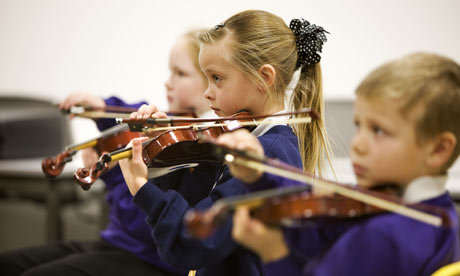
6. Have your child get involved in music at school. If your child's school has a choir, a band, or an orchestra, go for it. Your child will learn to read music and try to learn different instruments.


7. If your child has the opportunity, take private music lessons on his/her favorite instrument. Private lessons are sometimes available at local community centers and education programs.


8. Encourage your child to become aware of the music around him/her. Start by taking a few minutes to listen to the music and rhythms of nature, or the rhythms in the busy world traffic, people, or machines.


9. Encourage your child to compose a song or musical piece. Try letting your child use composition software to create original music.


10. Let your child start a band. Have your child's friends create their own rock band, rap group, a cappella choir, or other musical combo. Then they can perform at school or in the neighborhood.

Monday, April 26, 2010

Music Smart Children

All children have natural abilities and learning styles that make learning easier for them. Some children are "Music Smart". If you answer yes to any of the questions below, then your child my just be identified as "Music Smart" according to Thomas Armstrong.

Does your child:
1. enjoy singing?
2. like to listen to music?
3. play an instrument well?
4. read music?
5. remember melodies or tunes easily?
6. hears the different instruments being played together?
7. hums or sings while thinking or doing task?
8. easily picks up rhythms in the sounds around them?
9. likes making musical sounds with their body (humming, clapping their hands, snapping their fingers, or tapping their feet)?
10. makes up or writes their own songs or raps?
11. remembers facts by making a song for them?


This week I will give you information on "Music Smart" children and also suggestions on how to make your child more "Music Smart". So read my blog all week for more information on the "Music Smart Child".

Sunday, April 25, 2010

Brush Up Your Memory

Forget to floss, and you may soon have trouble recalling names, your grocery list, and the question you were asked five minutes ago. In a study of more than 2,300 men and women age 60 and over, those who scored the lowest on simple arithmetic and memory task - making mistakes similar to patients with early Alzheimer's disease - had gotten most exposure over the years to a particular gum-disease-causing bacteria. (The researcher could tell from blood test.) "When it comes to preventing dementia and other chronic diseases, it may be just as important to brush, floss, and go to the dentist as it is to take your blood pressure medication," says James M. Noble, M.D., of Harlem Hospital and Columbia University Medical Center. If it is that important for seniors to take care of brushing and flossing, how much more important is it for our children to begin taking care of their dental health. Make it a habit of everyone in your family brushing and flossing at least once a day. Twice a day is even better!!

Saturday, April 24, 2010

My Child Can Never Find Socks and Shoes

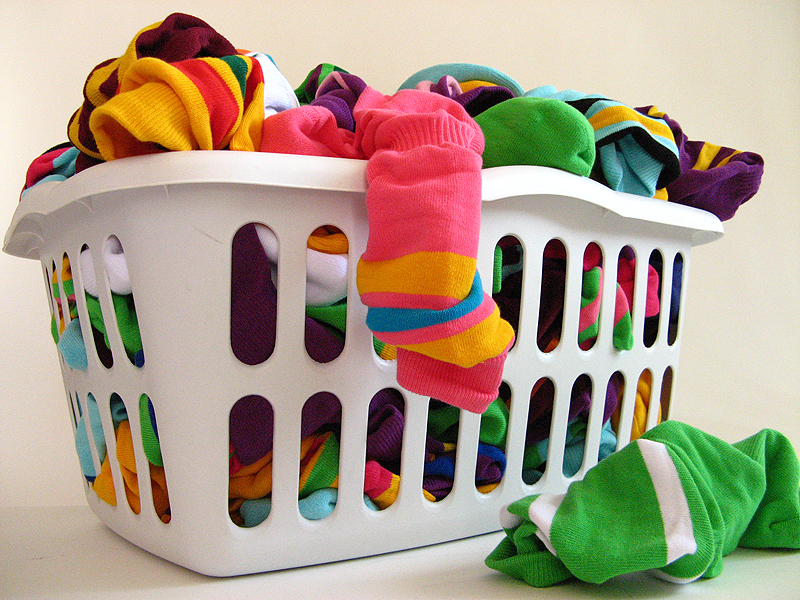
According to "Better Housekeeping", May 2010 issue, whether they don't land in the hamper or are eaten by the washer, stray socks litter the laundry room and clog drawers. Collect clean socks in a bin or bag by the dryer. Then host a re-pairing party (invite the kids to participate) to match up the stragglers, Use leftover socks for dusting.

In an idea world, kids would pair their shoes neatly at the bottom of the closet. Get real, and place and old laundry basket on the closet floor to contain footwear and shoes are a lot less likely to walk off if they are kept together.

About This Blog

This weblog seeks primarily to be a resource to parents and their children facilitating, "Empowerment & Personal Responsibility through Education."

This weblog is an extension of BestEducationPossible-theCommunity an online community dedicated to Parents and their efforts to empower their children through Education.


How to get the Best Education Possible for Your Child

How to get the Best Education Possible for Your Child
Click Picture to Buy It Now!

Blogger templates made by AllBlogTools.com

Back to TOP